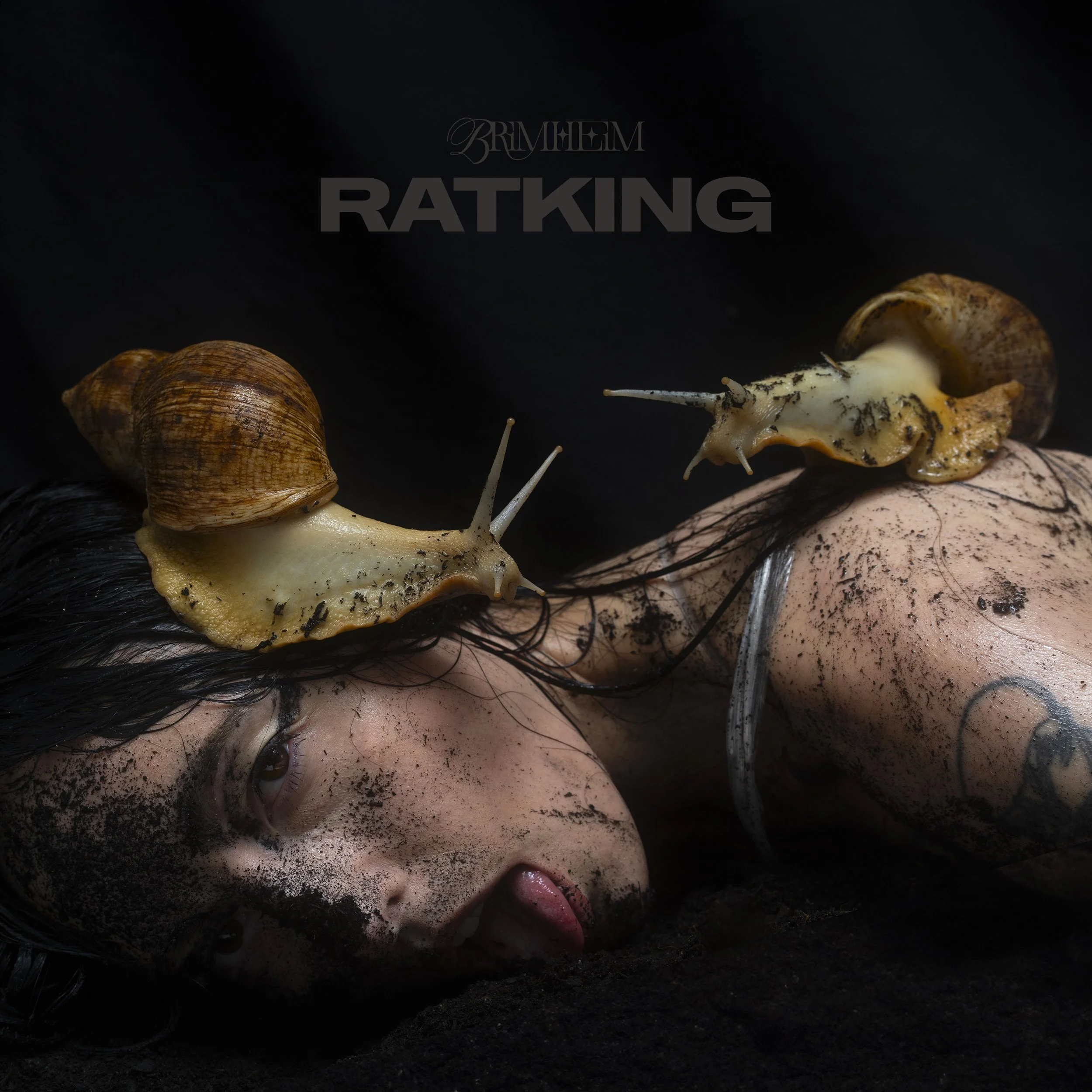
It’s a messy business, becoming. Shady corners of our minds are filled with the debris of it, our cognitive junk drawers crammed with stray desires. For some it’s enough to just store these wants away, if by storing we mean throwing down a memory hole and hoping for the best. But for others, like Brimheim, it’s a question of what new shapes can be fashioned from the longing, and what else might reveal itself if held up to the light.
Since emerging in 2020, Malmö-based Helena Heinesen Rebensdorff has made an artform out of self-examination and olive-branching with her shadow side, having spent years fighting to somehow correct it. Vulnerability makes for an easy headline, of course, but those have all been written before and, in any case, is a surface level reading of her ambition. The arc of self-acceptance is fine, it’s something we can all relate to, but as the driving force of creation? No thanks. "Relatability is overrated. It's the least interesting thing art can give you," she says. “I want magic. I need the extraordinary.”
Born in Copenhagen to a Danish father and Faroese mother, from whom she borrowed the name Brimheim (a word that translates roughly to “home of the breaking waves”), growing up partly in the Faroe Islands set a baseline level of wonder that has stuck with her for life. It is the country of the Huldufólk, after all, the hidden people of the landscape who, as Brimheim says, “you do not want to fuck with.” They’re not above stealing your children if you do, so staying on their good side is advised. And, as it turns out, holding space for what you cannot see is quite a high vibrational place to work from creatively.
Raised among authors and artists who went against the conservative grain of Faroese society, Brimheim’s early years were shaped by a feeling of closeness to ancient stories and myths. A songwriter since the age of nine, and more determinedly since her time at both the Royal Academy of Music in Aarhus and the Rhythmic Music Conservatory in Copenhagen, Brimheim describes her method as a process of digging around until she hits a main artery or a seam of precious ore, a place where something juicy can happen.
“I can’t stand blind certainty,” she says. “I always want there to be some sort of friction to my music, some weird colour that I throw on the canvas, and I will protect that no matter what. Even when I’m dealing with darkness, I never want to be one-dimensional with it.”
Enter RATKING (2024), Brimheim’s triumphant villain era that saw her leaning further into abstraction, doubling down on her own contradictions and music as a sandbox for theatre of the absurd. The guitar-driven catharsis of her 2022 debut can’t hate myself into a different shape remained, but this time it came with pop and electronic reinforcements – polished, made stranger, and put under glass, like some grotesque exhibit. Championed by The Line of Best Fit, GAFFA, KEXP, and others, RATKING went on to double wins at the Faroese Music Awards and Danish independent music awards Den Uafhængige, and a nomination for Danish Album of the Year at the 2025 Danish Music Awards.
Having come up as a visual artist and co-owner of an artist-run gallery among the Copenhagen DIY art scene of the early 2010s, Brimheim sees symbolism in the same way she sees magic (non-negotiable, frankly) and, once unleashed, it was clear that RATKING couldn’t just fade away. The monarch had to die, and die she did, shot down on stage earlier this year in Copenhagen’s Norrebrø Theatre, her worst traits beaten back to the storerooms of the mind, awaiting their next role.
Out of what remained, Brimheim claimed courage, a keener will to be brave and more alert to her strengths. She still sometimes wrestles with self-doubt and existential dread, but now the fear doesn’t have to equal a white flag. “I want to feel it all and face the things that scare me most,” she says, and her upcoming third album Fables is the most dramatic rewrite of the Brimheim story yet. Here, a new harmonic language emerges, rooted in 1970s progressive folk chords and hallmarks of vintage pop.
“Making this album has changed the way I think about songwriting. I still love all the flashy production of RATKING, but I’ve learned that, for the type of artist I am, it’s the song that reigns supreme, and that’s the craft I’m ultimately interested in.”
Inspired by the lineage of singer-songwriters from Dory Previn and Nick Drake to Loren Kramar and Father John Misty, Fables weaves a dreamlike spell from somewhere out of time, using archetypes and fiction to reach a deeper truth. Drawing on her background in art history, she leans more fully into abstraction, partly as a way of accessing the sacred, the lost magic of her younger years, and setting down the burden of having to explain.
“In visual art, you live in a world full of symbols, that’s really the baseline,” she says. “But I feel like, often in music, there’s a pressure to justify abstraction or ambiguity instead of trusting it to evoke something on its own. I love songs that give you a sense of something bigger, something that can’t be held by a single definition. That’s magical to me.”